



Starting an architecture firm is a dream for every young architect. However, there is a huge difference between a dream and a reality. To start an architecture business, you need to understand the architecture business model, your business development capabilities, and many other factors.
You might think that being a licensed architect gives you that little edge to get things started as a business owner, but that is not true. In fact, you might face many potential risks and legal consequences if these small details are overlooked.
So, how to start your own architecture firm? What are the key steps it involves?
In this blog, we will explore everything about an architecture business, from what it is to key steps, cost factors, and challenges it involves. Let’s get started!
📌 Key Takeaways
- An architecture firm focuses on designing buildings and spaces that reflect client needs and leave a lasting impression.
- Market research and competitor analysis are essential first steps when starting an architecture business.
- Legal setup, licensing, and business registration ensure your architecture business operates legitimately.
- To build a strong brand, emphasize marketing, website optimization, and consistent social media presence.
- Once your business is running, maintain financial accuracy by using reliable tools and software.
What is the Architecture Firm Business Model?
Architecture is a combination of creativity and technical expertise.
But beyond creativity and expertise, it is a service-driven business model that requires excellent client relationships and efficient project management to succeed. The three pillars of an architecture business model are: the services you offer, your business strategy, and your revenue structure.
1. Services Offered
An architecture firm is more than just providing blueprints. They offer end-to-end solutions that may include architectural design and planning, interior and landscape design, 3D modelling and visualization, project and construction management, sustainability consulting, etc.
2. Business Strategy
A well-planned business strategy of an architecture firm decides where it will go in the long run. If your budget is limited, you can focus on a single segment, such as residential or commercial. It will give you financial freedom and help you focus on other parts of your business.
3. Revenue Structure
The pricing model you choose will determine how much revenue you will earn in one specific period. You may need to estimate projects and generate financial reports to structure the pricing model properly. The pricing models are as follows:
- Fixed-fee model
- Percentage of construction cost
- Hourly billing
- Retainer-based contracts
Simplify Your Firm’s Finance with Ease!
With Moon Invoice, you can automate payments, invoices, reports, and track expenses effortlessly – all in one place!
7 Essential Steps to Start an Architecture Business
Now that we have understood the business model of an architecture firm, you must be keen to learn how to start an architecture firm. Below are the key steps to starting an architecture business.
1. Research Market and Define Niche
Whenever you start a business, the first step is to research the market thoroughly. It gives an idea of the latest trends, current demand, and what the future holds in the long run.
Start your market research with a clear objective. Ask yourself a few questions while doing your market research on starting an architecture firm:
- Is there local demand for high-end residential restoration?
- Can you win repeat work from commercial landlords?
- Is sustainable (net-zero) design a growing segment in your city?
Once you get the answers, you will know how to plan your business for long-term success.
You also need to do competitor analysis before moving on to defining your niche. Identify nearly 5-10 direct competitors. Every competitor you identify should be categorized based on:
- Services they offer
- Clients and project size
- Pricing plans
- Brand position
- Strengths and weaknesses
After doing competitor analysis, you can define your niche. Some of the common ways to define a niche for your own architectural firm are as follows:
- By client type (boutique homes, co-living)
- By building type (retail, healthcare)
- By specialty (passive-house, adaptive reuse)
- By process (fast-track design + permit service)
- By price band (affordable vs luxury)
When you define your niche, you will get more clarity on creating strategies for your business.
2. Build a Strong Architecture Business Plan
Once your research is done, next you need to create a structured roadmap for your business. In this step, you will clearly define your goals, create methods on how you will operate your business, and plan finances.
First, define your business’s vision and mission. Vision should be about how you can create sustainable, human-centered spaces. Mission should be how you will execute plans and put innovative ideas to deliver architectural solutions that redefine urban living.
After defining your vision and mission, you need to create a plan for how your business operation will run on a daily basis. You need to consider the below:
- Structure of your business: Define whether it is a sole proprietorship, a partnership, an LLC, or a private limited company.
- Roles and responsibilities: How you will delegate your work to employees in different departments, i.e., design, finance, marketing, etc.
- Set up project workflow: From getting the deal to concept design, approval, and execution, everything should go in a proper workflow.
- Set up tools and technologies: Which are the tools and technologies you are going to use for completing projects? Be it for design development, project management, or invoice management, you should define your tools beforehand.
Once the business operations flow is clear, you can set financial goals for your business. Your finance roadmap must include startup costs, operational expenses, revenue projections, and profit margins.
3. Legal Setup and Licensing
After solidifying your business plan, you need to make sure your business is legally organized and complies with all required licenses. A legally organized architecture firm means you are compliant with state and federal laws, protected from liabilities, and operate your business legitimately.
Here’s how you can legally establish and license your architecture firm.
- You need to register your business name and entity with the state’s Secretary of State’s office.
- Check whether your business name complies with the state architecture board rules. Some states don’t allow the use of “architect” or “architecture” in firm names unless the owners are licensed architects.
- Obtain Employer Identification Number (EIN) from the IRS. Without an EIN, it is not possible to open a business bank account, hire employees, or file taxes.
Next, you need to consider obtaining the architecture firm license.
In the U.S., every state regulates architectural practice separately, so you must check the specific licensing requirements of your state. In a general scenario, to get licensed:
- You must have a valid individual architect license issued by your State Board of Architecture.
- Your firm must have a firm license or a Certificate of Authorization (COA) to run an architecture business legally.
Later, based on your city/state, you need to obtain a general business license, zoning permit, and sales tax registration (if applicable).
4. Build a Strong Team and Vendor Network
Even the most skilled architect can’t accomplish large-scale projects all by himself.
An architecture firm must consist of qualified architects and an experienced design team. Plus, another advantage would be managing vendors and building partnerships with contractors and consultants.
Let’s look at how you should build your team and create a network of trusted vendors and partners.
Make sure your firm covers all essentials of the architecture business. You need to hire individuals in the following roles:
- Project architect: The most experienced person who will oversee the architectural design execution and maintain quality standards.
- Junior architect: The person who will handle CAD drawings, modeling, and revisions.
- Interior designer: The person who will be responsible for adding aesthetics to designs and detailing.
- Project manager: The one who will make sure everything is on time and will also communicate with vendors and clients to get the deal done.
Apart from the CEO, managerial employees, marketing, and finance team, the above roles are the core part of your architecture business.
After hiring your team, focus on building strong relationships with vendors and partners. You can consider collaborating with structural and MEP engineers (Mechanical, Electrical, Plumbing), civil contractors, material suppliers, 3D modeling and rendering vendors, etc.
5. Get Your Billing Software
Now you know how to build a team and create a vendor network, but we are missing a key part here, i.e., billing & invoicing.
With time, your architecture firm will grow, and investing in billing & invoicing software can be a smart choice. It will keep you out of manual work hassles like missing data and error-prone entries, and, most importantly, save you a lot of time.
A professional billing & invoicing software such as Moon Invoice can help architects create estimates, track project expenses, send invoices on time, and monitor every payment. An organized financial system with steady cash flow keeps your administrative work running smoothly.
Year by year, your architecture project numbers will increase, and so will your financial needs. But when you already have a billing & invoicing software in use, there is nothing to worry about. It keeps your business finance accurate and stress-free.
6. Marketing and Client Acquisition
You have done the hard yards. The foundation of your architecture firm is complete. Now, you need to make sure your firm is profitable and visible on the internet.
Strategic marketing and branding are what transform your firm into a trusted and recognizable brand. In this section, we will explore how you should market and acquire clients.
Here’s how you can market your architecture firm:
- Build a brand identity: Choose a name and logo that are easy to remember and reflect your design philosophy. The logo should be minimal and eye-catching.
- Create an online presence: Your website needs to clearly showcase what you do and your expertise, with well-optimized SEO. Manage your social media accounts regularly by posting images, videos, stories, and more.
- Implement smart marketing strategies: Authentic storytelling and consistent visibility grab attention. Get started with content marketing and email marketing to stay on top of clients’ minds.
- Participate in events: Look forward to attending architecture expos, design conferences, and local community events. These are great ways to showcase your brand and meet with potential clients.
Once your marketing strategies are in place, next you should focus on acquiring clients. You can consider the key practices mentioned below:
- Free consultation: To attract new clients, you should offer free consultations or project audits.
- Maintain professionalism: Listen to client needs, then propose your plan and proven methods to complete projects.
- Follow up consistently: Even after projects are completed, keep in touch with clients to maintain rapport.
- Request for testimonials: You can ask your already served clients to write a testimonial.
Clients generally consider firms that are technically sound and have proven work experience.
7. Manage Operations and Projects
With all your marketing and client-acquisition strategies now in place, your architecture business is up and running — but wait a second. How are you planning to manage projects and overall operations? This is exactly what we are going to discuss in this step.
Firstly, you should invest in tools that save time and keep your projects organized.
There are multiple advanced project management tools available on the internet. The tool you choose should help you manage your projects effectively.
These tools offer features like time tracking, which allows users to log billable hours with the help of the built-in time tracker and convert billable hours directly into invoices.
Once you select a project management tool, next you should think of managing every project effectively. Here’s how you can do it.
- Internal communication: To align everyone’s schedule for weekly project review and increase cross-department communication between design, finance, and marketing teams.
- Monitor budgets and expenses: Review expense-to-budget ratios weekly and use invoices and estimates to maintain transparency with clients.
- Focus on quality control: Review design documents before final submission and visit the site to inspect in critical stages.
- Manage client and vendor relationships: Keep clients updated with every progress report and maintain transparent communication to avoid disputes.
- Improve and scale: Consider outsourcing repetitive tasks and introducing training programs for teams to improve skills.
With time, keep refining your processes to handle larger projects.
Only wondering about “how to start an architecture firm” won’t help. You need to act first. If you follow the steps mentioned above, you can successfully start an architecture firm.
Manage Multiple Projects Painlessly with Moon Invoice.
Monitor how much time your team spends on a specific project task.
Log project hours
Create timesheets
Share reports

How Much Does Starting an Architecture Firm Cost?
The cost of starting an architecture firm starts from $20,000 to over $100,000 based on your business structure, planning, and budget. Architecture is a large-scale business and requires careful planning. The major expenses it can take up are hardware, software, legalities, marketing, and office setup.
Initially, you can reduce costs for some parts of your business, but a larger budget is required to operate as a traditional office.
Challenges in Running an Architecture Firm
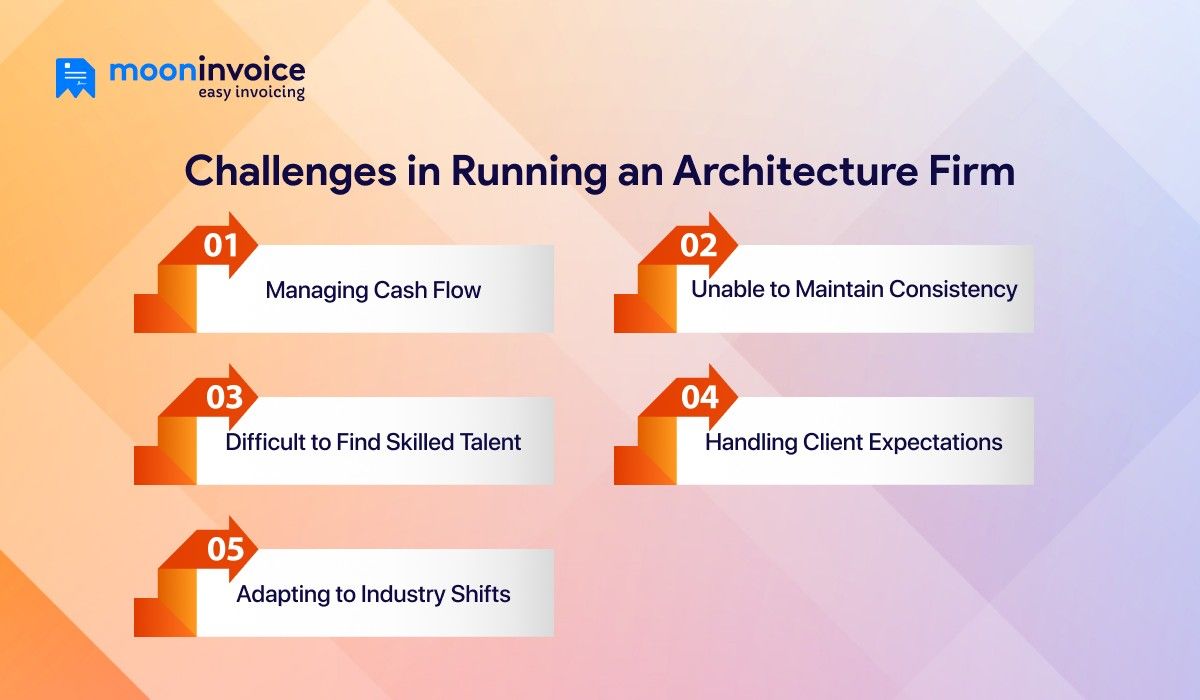
Owning an architecture firm comes with lots of challenges. Even though all the necessary steps are in place, you still need to make sure challenges don’t affect your business.
Below are some of the most common challenges architecture firms face.
1. Managing Cash Flow
Architecture projects go on for a long time, as they require detailing and perfection in every aspect. The long timelines, staggered payments, and unpredictable client schedule could raise serious cash flow issues. You may not be able to maintain steady revenue without tight financial control and real-time expense tracking.
2. Unable to Maintain Consistency
Generally, the idea behind starting a firm is to gain creative freedom, but to successfully run it, you need to check every part of your business. Beyond design, you have to handle marketing, hiring, invoicing, and client deals. This constant hassle could degrade your work quality and disrupt your creative focus.
3. Difficult to Find Skilled Talent
The demand for skilled designers, architects, and project managers is always high, which makes it difficult for architecture firms to hire or retain talent. Training or hiring new talent requires time to match the firm’s design philosophy.
4. Handling Client Expectations
The demand, goal, and expectations of every client are not the same. Some clients change designs frequently, and others come with tight deadlines or budgets. Dealing with all of these could lead to miscommunication, frustration, or project delays.
5. Adapting to Industry Shifts
Architecture is an ever-evolving industry, with frequent changes in design trends. Currently, the rise of building information modeling (BIM) and AI-assisted design tools has redefined how architects work on present ideas. Firms that fail to adapt to new changes may fall behind in the long run.
How Moon Invoice Simplifies Financial Management?
Starting your own architecture firm is a mix of both ups and downs. When your operations are going smoothly, you are getting consistent projects, and finances are managed properly, your architectural firm is most likely to thrive. But everything we imagine doesn’t really fall into place. One common example is handling the finance part of your business manually.
Your finance team is a critical part of the business, and manually managing everything leads to errors, frequent changes, delays, and more. To address all these issues, you should think of using software such as Moon Invoice.
Here’s how Moon Invoice simplifies the financial management of architectural firms:
- Customizable Templates: Choose from over 66+ customizable invoice templates to create invoices for your architecture business within 60 seconds.
- AI-powered Quick Scan: Convert your paper documents into digital documents, such as invoices, expenses, credit notes, etc., with the help of AI automation.
- Expense Tracking: Track and manage expenses of your architectural business smartly, with the option to attach documents or receipts to expense entries.
- Financial Reports: Access 15+ high-quality business reports to track, measure, and stay on top of finances.
Wrapping Up!
Starting an architecture firm can turn out to be one of the best business decisions due to the growing demand for aesthetically pleasing designs. When you own a business, your responsibilities increase; you are not just an architect anymore! You will have to overlook every part of your business, starting from getting projects to design requirements, marketing, finances, and client communication.
While setting up your business, don’t fall into the trap of manual work. It delays everything, and the risk of committing errors increases, which declines your growth potential.
You can consider using tools like Moon Invoice that help you ease your financial hassles and save time. You can create invoices, track expenses, and generate financial reports all within one tool. Start your free trial now!
FAQs
How to start your own architecture firm?
How profitable is an architecture business?
How to grow your architecture business?
What is an architectural firm?
What are the benefits of starting an architecture business?


Jayanti Katariya is the founder & CEO of Moon Invoice, with over a decade of experience in developing SaaS products and the fintech industry. He holds a degree in engineering. Since 2011, Jayanti's expertise has helped thousands of businesses, from small startups to large enterprises, streamline invoicing, estimation, and accounting operations. His vision is to deliver top-tier financial solutions globally, ensuring efficient financial management for all business owners.


